

If you have ever stood in front of a supplier’s order form trying to decide between stitching and ink, you already know the debate: embroidered vs printed flags. Both look good in a photograph, both can carry the same logo, and both can be made in almost any size. The difference shows up in how they feel, how they age, and how much they cost — and that is what this guide is about.
At FlagsWin, we produce both types daily in our Weifang workshop, so here is a practical breakdown of where each method genuinely earns its place.
How Embroidered Flags Are Made
Embroidery is a stitched construction. The design is digitised into a stitch file, then a multi-head embroidery machine runs coloured thread across a piece of fabric — usually a durable woven polyester, satin, or felt backing. On traditional national flags, the stitched build often goes further: separate panels of coloured fabric are cut and joined together, which is what people mean when they ask for a sewn flag rather than a printed one.
Typical characteristics:
- Raised, textured surface with visible thread and a slight sheen
- Colour comes from dyed thread, not from ink laid on fabric
- Edges are usually folded and stitched, sometimes with a reinforced hoist
- Heavier and stiffer in hand than a printed flag of the same size
- Both sides generally read the same way — a natural advantage for two-sided use
How Printed Flags Are Made
Printed flags place ink directly onto fabric. The two methods you will meet most often are dye-sublimation (heat transfers the design into polyester fibres — sharp detail, full-colour gradients, photographic imagery) and screen printing (thicker ink layers, strong solid colours, cost-effective at volume).
Typical characteristics:
- Flat surface with fine detail — small text, thin lines, multi-colour logos
- Wide colour range, including realistic gradients and photographs
- Lighter weight, so it catches light wind more readily
- Single-reverse or double-sided print options available
- Generally lighter on the budget at larger sizes
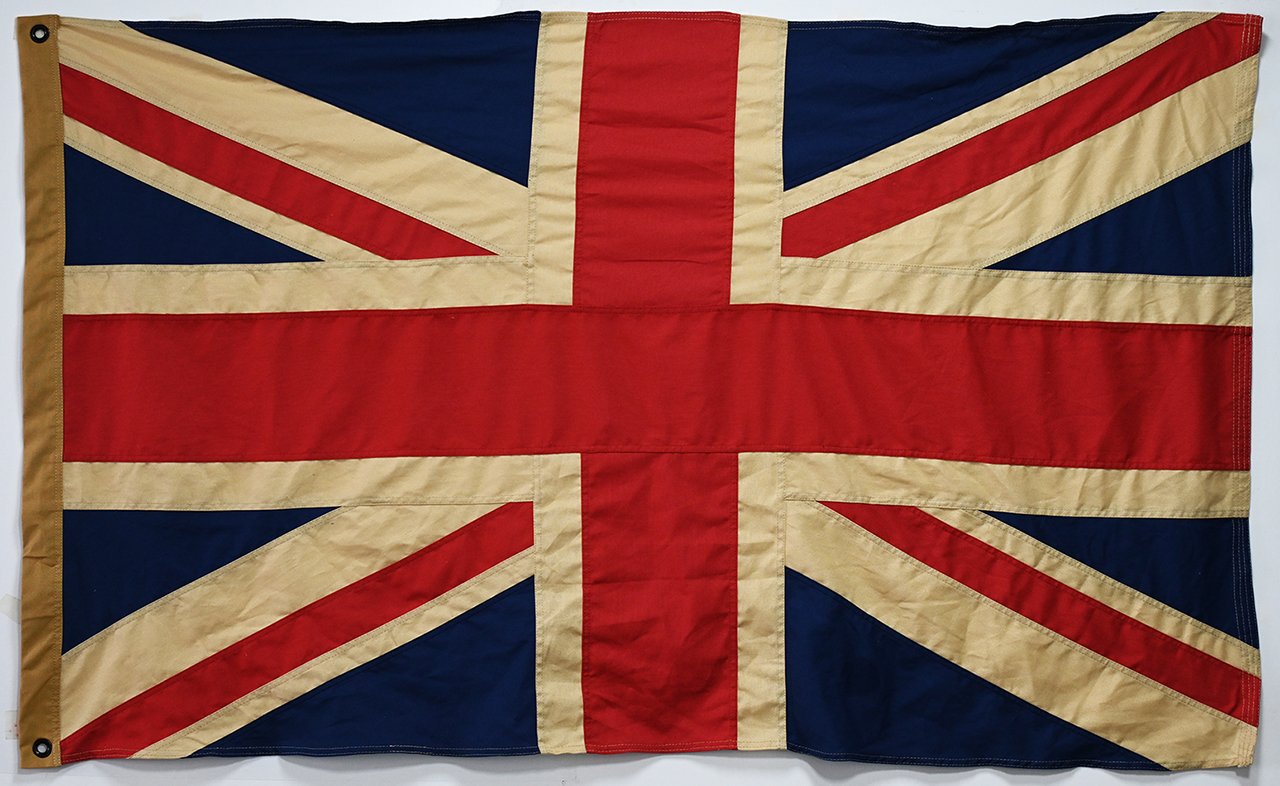
Embroidered vs Printed Flags: Side-by-Side
| Factor | Embroidered | Printed |
|---|---|---|
| Look and feel | Textured, premium, traditional | Smooth, modern, photographic |
| Fine detail | Limited by stitch size | Excellent — very small text is possible |
| Colour range | Thread colour range, solid blocks work well | Very wide, including gradients |
| Weight | Heavier, stiffer | Lighter, softer drape |
| Two-sided display | Readable from both sides by nature | Requires a double-sided print build |
| Relative cost | Higher, especially with dense stitching | Lower, and scales well with quantity |
| Typical use | Indoor display, ceremonial, presentation | Outdoor flying, events, large banners |
When an Embroidered Flag Is the Better Choice
Choose embroidery when presence matters more than portability. A custom embroidered flag carries a sense of weight and craft that ink simply does not reproduce — the thread catches light, the surface has depth, and it photographs well in indoor conditions.
Embroidery tends to be the right answer for:
- Indoor and ceremonial display — auditoriums, boardrooms, courts, memorial settings, colour-guard presentations
- Club and association flags that are carried rather than flown in high wind
- Presentation and gift pieces — framed flags, retirement gifts, commemorative editions
- Designs built from solid colour blocks — crests, simple emblems, bold lettering
- Reversible display needs, where the design must read correctly from both sides without a double-print build
Two things to keep in mind. First, very small text and thin outlines may need to be simplified, since thread has physical width. Second, embroidery adds weight, so a large stitched flag needs a solid pole and mounting hardware to stay steady.
When a Printed Flag Is the Better Choice
Printing wins on detail, weight, and value — and for most outdoor flying, it is the practical option.
- Outdoor flying on a pole — lighter fabric moves in gentle breezes, so the design stays visible
- Logos with gradients, photographs, or fine type, which embroidery cannot reproduce faithfully
- Large sizes — printing scales up without the weight penalty of dense stitching
- Volume orders — promotional runs, event flags, retail displays
- Short-term campaigns where cost per unit drives the decision
For outdoor use, printed flags are typically finished with reinforced edges and a strong hoist, and they hold colour well when made from quality polyester and handled sensibly.
A Middle Path: Appliqué and Combination Builds
You do not have to choose one or the other. Many traditional flags combine both techniques — large colour fields are sewn from separate fabric panels, while fine details, lettering, or emblems are embroidered on top. This gives you the depth and structure of a sewn flag with sharper detail than stitching alone could deliver, and it is a common approach for ceremonial and official-style flags.
A Quick Decision Guide
Pick embroidered if…
- The flag will mostly be displayed indoors or carried by hand
- You want a textured, traditional, presentation-grade finish
- Your design uses solid colour blocks and reads clearly from both sides
- Budget is secondary to the sense of occasion
Pick printed if…
- The flag will fly outdoors regularly
- Your artwork has fine detail, gradients, or photography
- You need a large size or a high quantity
- You want the lightest fabric for the best movement in low wind
Practical Ordering Notes
Whichever direction you take, a few details decide how happy you will be with the result. Send vector artwork where possible so colours and proportions translate cleanly. Tell us how the flag will be used — indoor display, parade carry, or permanent outdoor pole — because that shapes the fabric weight, edge finishing, and attachment style. And if your design sits somewhere between the two techniques, ask about a combined build; it is often the sensible middle ground.
Embroidered vs printed flags is not really a contest. It is a question of matching the construction to the job: stitching for presence and ceremony, printing for detail and outdoor performance.
Ready to see how your own design would look? Browse the custom flag range at flags-factory.com and send us your artwork — we will advise on the finish that suits your use case.
Email: flagswin@flag-win.vip
WhatsApp: +86 13031678795
Facebook: https://www.facebook.com/StarFlagFactory/
Alibaba.com: https://wfqyflag.en.alibaba.com/
