

California State Flag: Design, Materials & Durable Outdoor Buying Guide
The California state flag — the “Bear Flag” — is one of the most recognizable state flags in the country. Its bold red star, upright grizzly, and blunt two-word declaration give it a graphic power that reads clearly from a distance, whether it’s snapping over a state building, hanging in a classroom, or flying from a porch on a summer afternoon. That same boldness is also why buyers need to think carefully about materials: a flag this graphic deserves fabric that keeps its shape and color through sun, wind, and rain.
This guide covers what the design actually contains, how those design details interact with wear and tear, and what to look for when you’re purchasing a California flag for outdoor display.
What’s on the California State Flag?
The California flag is built from a small number of strong elements, each with a specific role in the composition:
- White field — the base color, taking up most of the flag’s surface.
- Red five-pointed star — placed in the upper hoist (the corner nearest the pole).
- California grizzly bear — the central figure, walking on a patch of green grass and facing the hoist.
- “CALIFORNIA REPUBLIC” — black lettering set below the bear, aligned in a single line.
- Red stripe — a horizontal band running along the bottom edge of the flag.
The design traces back to the Bear Flag Revolt of 1846, when settlers in Sonoma raised a hand-painted flag declaring an independent California Republic. The version we know today was adopted as the official state flag in 1911, and the artwork was standardized by later state legislation so that manufacturers would produce a consistent design rather than a series of loose interpretations. The bear depicted is a California grizzly — a subspecies now extinct in the wild, which gives the flag an unintentional but fitting role as a memorial as well as a symbol.
Proportions and layout details that matter
Commercially produced California flags are commonly made in 2:3 proportions, the same ratio used for most national flags, which makes them easy to pair with standard poles and hardware. The critical design relationship is between the bear and the star: on a well-made flag, the bear sits roughly centered in the white field, the star is clearly separated from both the bear and the hoist edge, and the lettering stays level and legible. On cheaper flags, these elements can drift — the star creeps too close to the edge, the lettering crowds the bear, or the bear’s outline fills in and loses detail.
Because the design depends on fine black outlines and thin letterforms, it places real demands on the printing or appliqué method. When you evaluate a California flag, look at the bear’s edges and the text at the size you plan to display. If those details look muddy on a small sample, they will look worse at 5×8 feet.
Materials for an Outdoor California Flag
The right fabric depends on where the flag will fly and how much wind it will face. Here’s how the common options compare for outdoor use.
| Material | Character | Best suited to |
|---|---|---|
| Nylon | Lightweight, dries quickly, flutters in light breezes | Coastal and inland areas with moderate, steady wind |
| Polyester | Heavier hand, strong resistance to sun and moisture, holds color well | Continuous outdoor display and stronger wind exposure |
| Spun / woven polyester | Denser weave, softer drape, print clarity on fine details | Buyers who want the bear and lettering to stay crisp |
| Cotton | Traditional look and feel, minimal sheen | Indoor display, ceremonies, framed or wall-mounted use |
For a California flag that lives outside year-round, polyester is usually the practical choice: it resists moisture, stands up to UV exposure better than cotton, and holds the ink on those fine black outlines. Nylon remains a good option where wind is gentler and you want the flag to move readily. Cotton is a poor fit for permanent outdoor duty — it soaks up water, dries slowly, and the white field shows dirt quickly — but it looks excellent indoors.
Buying Tips for a Long-Lasting Outdoor California Flag
1. Check the fly-end reinforcement
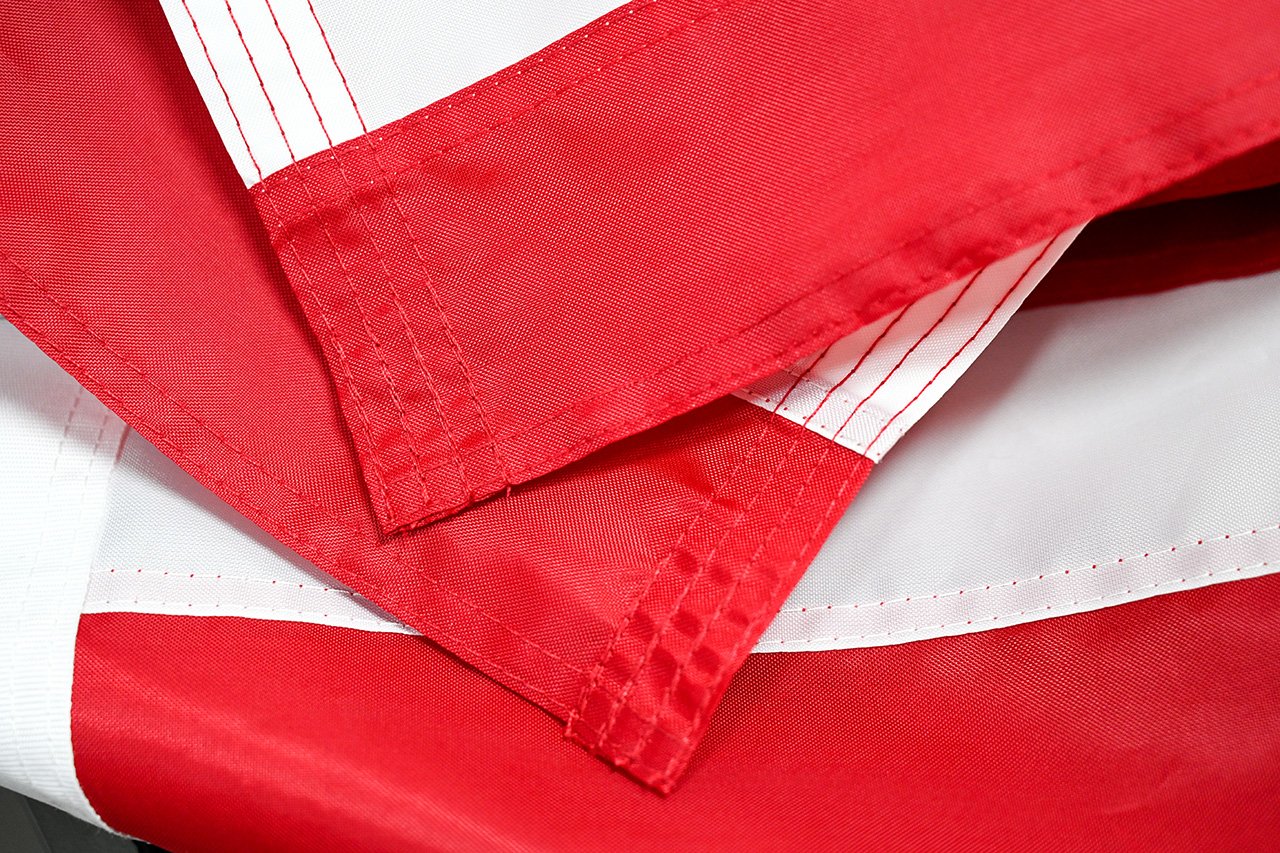
The fly end — the loose edge opposite the pole — takes almost all of the whipping force in wind. A quality California flag will have a reinforced fly hem, often with multiple rows of stitching and a folded edge. Thin, single-stitched hems are the first thing to unravel.
2. Consider the heading and attachment
Canvas header with brass grommets is the standard for pole display and works well on most residential and commercial flagpoles. If your pole has a halyard or you want a cleaner look, a pole sleeve (also called a pole hem) keeps the flag from sliding and reduces stress on the corners. Flags intended for parade or indoor use are often finished with a pole hem and gold fringe — attractive, but not the right choice for all-weather outdoor flying.
3. Match size to pole height
A flag that’s too large for its pole will wrap around the hardware and wear out early. As a general rule, a flag’s length should be roughly one-quarter to one-third of the pole’s height for outdoor display. Common California flag sizes include 12×18 inches, 2×3 feet, 3×5 feet, 4×6 feet, and 5×8 feet.
4. Look at how the design is applied
Printed flags offer sharp detail and consistent color; appliquéd or sewn flags use layered fabric for the star and stripes and can have a different feel and weight. For the California design, printing generally reproduces the bear’s outline and the lettering with more precision, while sewn construction gives a more textured, traditional appearance.
5. Ask about the inks and finishing
Fade-resistant inks and careful dye handling keep the red star and bottom stripe looking strong season after season. Ask what finishing steps are included — reinforced corners, clean cut edges, and consistent grommet placement all affect how the flag holds up.
Keeping the Bear Flag Looking Sharp
A few habits extend the life of any outdoor California flag. Take it down before severe storms, since high winds cause more damage than sun exposure. Rotate two flags if the pole is in constant use, letting each rest. Wash occasionally with mild soap and cool water, then air dry — never machine dry. And when storing, roll rather than fold the flag to avoid setting creases along the lettering and the bear’s outline.
When you’re ready to choose, look for a flag with strong hem construction, fade-resistant color, and design details that stay crisp — those three factors make the difference between a flag that lasts a season and one that lasts many.
Browse the California state flag and other state, national, and custom flags at flags-factory.com — we’re glad to help you match the right size, material, and finishing to your display.
