

A customer sends over a logo, approves a proof, and then asks the question that comes up in almost every conversation about this product: why does a flag that reads correctly from both sides cost noticeably more than one that doesn’t? The answer isn’t a markup for convenience. It’s physics, fabric, and labor. Here’s a clear look at how double sided flags are constructed, step by step, and where the extra cost actually goes.
First, What “Double Sided” Really Means
In flag manufacturing, “double sided” doesn’t simply mean “printed twice.” It means the artwork is legible and correctly oriented on both the front and the back of the flag. On a standard single-sided flag, printing is applied to one face of the fabric — the reverse side shows a faint, mirrored version of the design because dye soaks through the weave. That’s often called show-through, and for many uses it’s perfectly acceptable.
A true two sided custom flag is built differently. It has two separate printed faces, and between them sits an opaque middle layer that stops the two designs from interfering with each other. The result: someone standing on the street sees your logo reading left to right, and someone behind the flagpole sees the same thing — not a backwards ghost image.
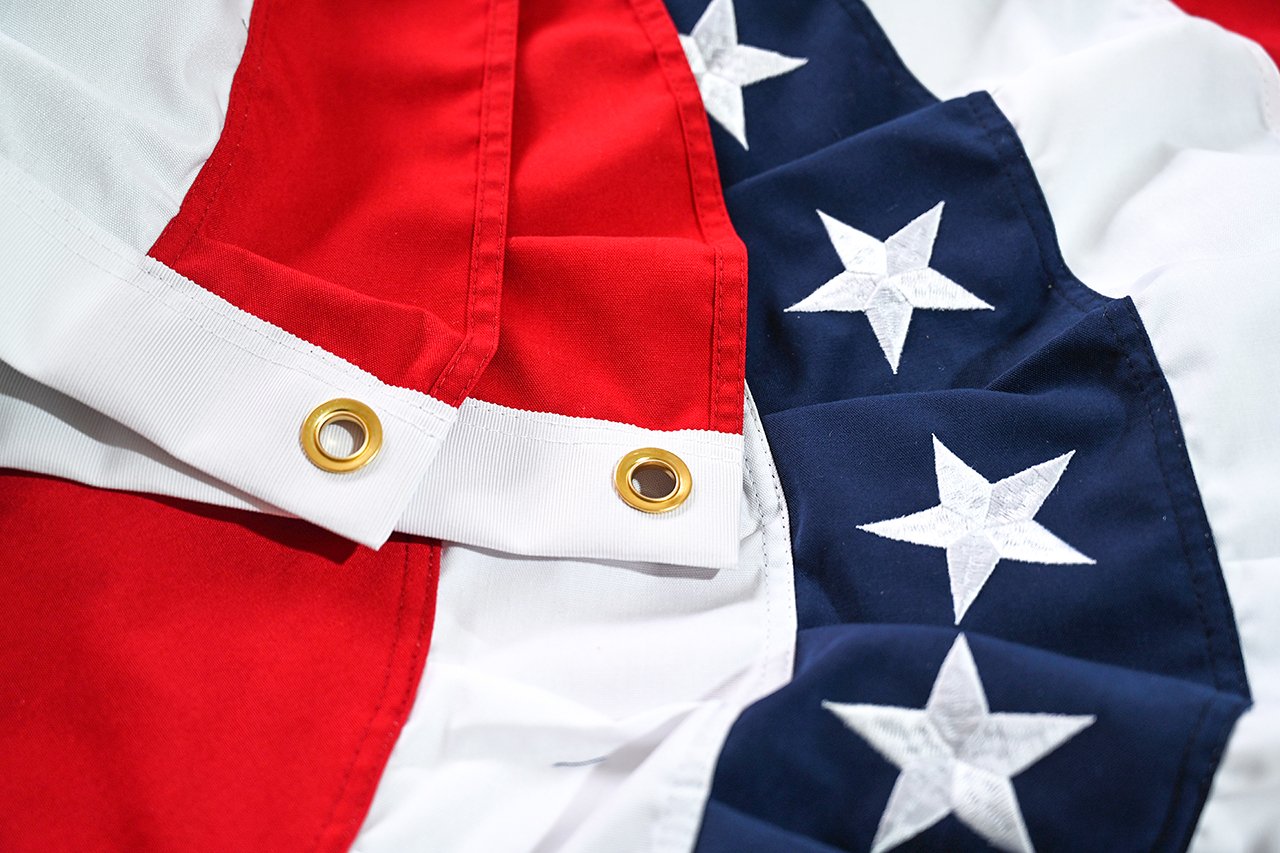
How Double Sided Flags Are Made
Step 1: Printing Two Separate Panels
The process usually begins with dye sublimation printing onto polyester fabric. Because the flag needs two readable faces, the printer runs two complete panels — one for the front, one for the reverse. Each panel is printed as its own mirror-correct file, meaning the artwork is oriented so it reads properly once assembled.
This is the first cost driver. A single-sided flag consumes one print run. Double sided printing flags consume two, along with the setup and proofing that goes with each. Print time, ink transfer, and fabric consumption all effectively double before a single stitch is sewn.
Step 2: The Blockout Liner
The middle layer is what separates a genuine double-sided flag from a “print both sides and hope for the best” attempt. It’s a dense, opaque fabric — often a blackout or tightly woven material — sandwiched between the two printed panels. Its job is to prevent light from passing through and prevent the reverse of one panel from bleeding into the other.
Without it, sunlight behind the flag would turn your carefully printed design into a muddled overlap of two images. The liner adds material cost, weight, and thickness, and it’s the single biggest reason a double-sided flag is heavier than its single-sided counterpart.
Step 3: Assembly and Alignment
Once the two printed panels and the liner are cut, they’re layered and stitched together around the perimeter. This stage demands patience rather than speed. The two printed faces need to line up so the design isn’t visibly offset from front to back, and the layers must be kept flat and free of wrinkles while the hems are sewn.
Flags with a header and grommets, or a pole sleeve, need extra reinforcement at the attachment points because of the added weight. Fly ends are typically finished with multiple rows of stitching to handle wind stress. Because three layers are involved rather than one, assembly takes measurably longer than building a standard flag.
Step 4: Finishing and Quality Control
After sewing, the flag is trimmed, inspected, and checked for alignment, loose threads, and hem consistency. Because alignment problems on a double-sided flag are visible from both sides, the tolerance for error is tighter, and more pieces get set aside during inspection. That rejection rate is a real — if invisible — part of the cost.
Why the Price Difference Exists
Put simply, a double-sided flag contains roughly twice the printed surface area, an extra layer of fabric, and more skilled labor per unit. Here’s how the two products compare:
| Factor | Single-Sided Flag | Double-Sided Flag |
|---|---|---|
| Printed panels | One | Two |
| Middle liner | None | Opaque blockout layer |
| Reverse side appearance | Faint mirrored show-through | Fully readable, correct orientation |
| Fabric weight | Lighter | Heavier, three layers |
| Sewing time | Standard | Longer, with alignment work |
| Shipping weight | Lower | Higher |
There’s also a practical knock-on effect: because a double-sided flag is heavier, it places more load on the pole, bracket, or halyard. Customers sometimes need to step up to sturdier hardware, which is worth planning for at the start rather than discovering later.
When Double Sided Printing Flags Are Worth the Investment
Not every project needs this construction. A single-sided flag works well for short-term promotions, indoor displays against a wall, or any setting where only one viewing angle matters. Consider the double-sided option when:
- The flag hangs from a pole in an open space where people approach from multiple directions
- A logo, sponsor name, or phone number must be readable — not mirrored — from the street side
- The flag is used as a permanent sign outside a storefront, dealership, or hotel entrance
- Brand presentation matters and a faint reverse image would look unfinished
- The flag is viewed backlit, where show-through is most obvious
A Common Misconception
Some buyers assume that ordering two separate single-sided flags and sewing them back to back produces the same result. In practice, without an opaque liner between them, the two designs show through each other when the sun is behind the flag, and the assembly tends to be bulkier and less balanced. Purpose-built construction handles the light-blocking properly and keeps the layers flat.
Choosing the Right Option for Your Project
If you’re weighing up a two sided custom flag for a storefront, event, or corporate display, it helps to share a few details up front: the viewing angles, whether the flag will be seen backlit, the pole type, and the expected wind exposure. Those details let a manufacturer recommend the right fabric weight and finishing without overselling the construction you don’t need.
Browse the custom flag range and request a proof at flags-factory.com — send over your artwork, tell us how the flag will be displayed, and we’ll help you decide whether double sided flags are the right fit or whether single-sided printing will serve you just as well.
Email: flagswin@flag-win.vip
WhatsApp: +86 13031678795
Facebook: https://www.facebook.com/StarFlagFactory/
Alibaba.com: https://wfqyflag.en.alibaba.com/
